Monday, 22 September 2014

Return to Hamelin, and the Eder and Möhne Dams (Part 2)


Part 2 has taken an effort to complete!
The caravan has been in the UK all year.
But we have still done our share of travelling around Europe and North America - without the caravan
- and around the UK, with the caravan.
And every new place seems to give us less free time.

But that’s not a bad thing.
It’s good to be busy without thinking about work.

As I wrote in Part 1 of this post, while we were in Germany, Gail and I also visited some of the destinations I remember from my childhood in Detmold.
Towns like Hamelin, and also the Möhne and Eder lakes and dams, were some of the places to go for a day trip.

Part 1 was all about Hamelin – Part 2 covers our visits to the Möhnesee and Edersee, and the famous dams.

The broad plan was to do as I had done as a child and, from Detmold, have a day trip to the Möhne dam and then a second day trip to the Eder dam.
But looking at the map, and thinking of the goal of getting South, and ultimately to Croatia, we firstly travelled with the caravan 50 miles South to Brilon.
From there the Möhnesee is 25 miles to the West, and the Edersee 40 miles to the South East.

Our first day trip from Brilon was to the Edersee.
It is a very pretty and large reservoir, surrounded by wooded hills.
It was this aspect that made the bombing of the dams in May 1943, such a challenge to the so-called Dambusters.
Although I remember visiting in the 60’s, the dam then was not such a visitor attraction.
I am thinking back 55 years.
Of course in 1960 it was just 15 years after the end of the Second World War, so it is easy to understand that wartime events associated with such constructions would rather be forgotten or avoided.
Today there is a gift shop and a museum,
and the lake is used for boating and boat trips.
We didn’t visit the museum,
but the advertising board clearly acknowledges the raid on the dam.


As we started to go away from the Eder dam to head back to Brilon, although stopping is prohibited, as it was quiet I quickly stopped to take a quick photo. 
Some weeks later back in the UK, I found an old photo mum must have taken of us all those years ago.
Parking restrictions must have been non-existent, and cars few enough to allow three young children to pose for the photo.
There are a few more trees around now!
This was just a mile away from Edersee – clearly an indication of modern day tourism!


. . . And a reminder of the days of greater NATO presence in Germany.
The following day we headed for Möhnesee. Approaching the reservoir there are many villages and small towns, with buildings that appear fairly recent. I don’t remember much around there on our day trips in the early 60’s. But at the reservoir itself, the scenery seems fairly unchanged.

You can stand fairly close to the foot of the dam, and I remember dad pointing out where the brickwork had been repaired following the bombing. Fifty years on the brickwork has weathered, with no sign of that night in 1943.

Unlike the Eder dam, there is no gift shop or museum, but there are a few information boards.


After walking across the dam and back, we decided to have a drink in the bar near the dam. 


This was there in the 1960’s, and in fact was the Seehof hotel in 1943. 
The owners have provided quite an information display about the hotel history, and the night of the bombing.


It must have been quite a shocking night for anyone there in May 1943.


On this visit my knowledge of the detail of the bombings had been increased by documentaries about the 60th anniversary of the raids in May 1943, together with reruns of the “Dambusters” movie. Visiting the dams once again, made me realise how many people actually lost their lives – 1200 at Möhnesee – mainly civilians, including prisoners of war. 

This was in addition to the RAF planes and men lost attacking the targets. The unanswered question from a strategic viewpoint is why it was decided not to disrupt the rebuilding work, with the Möhne dam operational again a year later.

Today I realise that dad had joined the Royal Navy probably aged just 15, and just after the end of the Second World War. While in Germany, he was a small part of the Cold War defence against the Eastern Bloc. At the age of 9 the realisation and understanding of war was a long way from my mind, and even more so to sister Lynda and brother Adrian.

The visit to the Möhnesee and the Edersee again brought back happy memories of a happy childhood. But it was tinged with sadness of the wartime events of 60 years ago, which I had no real knowledge of as a child.

Friday, 19 September 2014

Return to Hamelin, and the Eder and Mohne Dams (Part 1)


As I said in a previous post, while we were in Detmold, Gail and I also visited the some of the destinations I remember from my childhood. Towns like Hamelin, and also the Mohne and Eder dams, were some of the places to go for a day trip.


I remember Hamelin as a small town in the 1960’s, and don’t remember it as the sprawl that we saw on our visit. But certainly now, as then, the centre of the town has some beautiful traditional buildings. 


The town attracts nearly four million tourists a year mainly because of the world famous medieval legend of the Pied Piper of Hamelin. 

We bought a copy of the story in English thinking we could give this to Amelia when she gets older. I don't remember if I thought about it as a child, but reading the story again now, parental guidance is necessary! A story where all the children are led away by a strange man, never to be seen again, and nobody really knows where they went is really the stuff of nightmares. But the bit where the Pied Piper does what he promises, only for the politicians of the town to break their promise, still rings true.

Although the main visitor season had passed there were still a lot of people around, and we had a wander around looking at the traditional buildings, and spotting the brass rats in the pavement, 


and then waited, over a beer, for the twice daily ringing of the glockenspiel bells and the carousel of twirling Pied Piper figures at the Hochzeitshaus.


That was Hamelin – our visit to the Mohne and Eder dams next time.


Thursday, 18 September 2014

The Browns, 18a Niedersachsen Strasse, Detmold

Thursday September 18th, 2014
Just over 50 years ago, dad – Chief Petty Officer Bernard Edward George Brown – also known as Buster or Bomber - was posted from Lee-On-Solent, near Gosport, where the family were living at the time, to Detmold in Germany. 

Detmold is located just over an hour from Hannover, half an hour from Bielefeld, with Berlin 4 hours to the East, and Essen 2 hours to the West.

Although dad was Royal Navy – more precisely Fleet Air Arm – he and 2 other Chief Petty Officers were "on loan" to the Army Air Corps. I vaguely remember one was called Bill Sellars, and the other definitely Ernie Selwood. I went to school in Detmold with Ernie and Mary's daughters Yvonne, and Vivian. Both Ernie and dad were posted to Culdrose in Cornwall after Germany, and both generations all stayed friends. Vivian eventually married Keith in the year above me at Redruth Grammar school, and I worked with Yvonne in my first job at Lastonet in Redruth, Cornwall, and she had already married Tony. Everyone eventually moved away from Cornwall, but we all remained in contact for many years to follow.

Most Fleet Air Arm engineers had helicopter skills, whereas dad was "fixed wing". I am sure he had always said it was to train Army Air Corps engineers on small propeller planes like the Auster, but it could well have been the reverse. After a few months on his own, dad was able to arrange for the family to join him, and we all lived in a flat at the top of a German family's house in Horn, which is a village 10 minutes from Detmold. Soon after that we moved into a house on a married quarter estate in Detmold, on the edge of the Army/Army Air Corps base. 

The perimeter fence of the base (Hobart Barracks) was in front of where we lived, and there was a footpath which skirted the fence taking us to the gatehouse and then into the base where the school was located, as well as shops, and even a cinema. Of course there were lots of Conqueror, Chieftain and Challenger tanks, helicopters, and planes, as well as barracks for the soldiers and airmen who were among the tens of thousands of British, American and Canadian forces based throughout West Germany during the Cold War. The NATO forces were always seen as a possible delaying factor to an invasion by Russia and the Warsaw Pact countries, with 6000 NATO tanks heavily outnumbered by 50,000 Warsaw Pact tanks, although it was always debatable how many of these might have worked effectively! But there were enough to worry about. . .
 

Dad and Charlie Cable

As children we had little concerns about the Cold War, but I always remember the locals being a little concerned, especially when they saw dad in his Royal Navy uniform, which looked very much like a Russian uniform, and particularly when they were so used to khaki uniforms!


I also remember having concerns about dad's gas mask. This was always under the stairs with dad's kitbag, and we were allowed to try it on, but with dad saying "It is not a toy". I remember asking what is was for, and getting some sort of reassuring answer, but at the same time asking him that if he needed a gas mask why didn't mum and us children have one?

Like all the dads, our dad was often away for days at a time on military exercises. I remember one particular time when we were all woken up in the middle of the night with bright search lights at the front of the house, and soldiers loading up trucks to take all the military "back to base". Many times we would ask when dad was coming home, and many years after that realised mum really did not know, and looking more worried than usual. I also remember the night (Friday November 22, 1963) when Kennedy was assasinated, and mum and dad worrying how that would affect things in Western Europe, while trying not to worry us children.

Today I wish I had asked mum and dad more about those times. . . – and other times.

It was always on my list to revisit Germany. I have been to Cologne many times with work, and also to Hamburg, and Frankfurt, and although Detmold is not on the usual tourist trail of Brits in Germany, we headed in that direction from Bruges.

We parked the caravan at the only site we could find in the area, a town called Lemgo, and on our first full day set out to see what I could remember from my childhood. I could certainly remember we lived at 18a Niedersachsen Strasse in Detmold – some things you never forget. Maybe it was mum sewing our address into our school clothes that did the trick. . . Putting the address into the SatNav we were amazed that it accepted it!

As we drove closer, I expected the area to be cleared and replaced with an Aldi or Lidl or both, but it was so strange to see the married quarters estate pretty much as it was in the 1960's. Trees were taller, and there were satellite dishes on roofs. 


I thought the skylights in the roof were new, but looking at an old photo once more, they were there in the 1960's.


All of the houses appeared empty – but not boarded up – and looked recently painted. Although all appeared unoccupied there was no sign of vandalism – which is something that you would expect in such a location in the UK. I parked the car in front of the house next to where the base perimeter fence used to be.


There are now expensive looking houses where that perimeter used to be, but the footpath I used to walk to school was there. With hindsight I should have taken a stroll along it, but just took a few photos.


On leaving the area of the house, we went out of the estate a different way to what we had come in. As we turned the corner, we saw a small area of grass and I remembered Santa Claus arriving by helicopter and landing on that grass. 


There is no way that would be allowed today – maybe it wasn't then – but it was great at the time for all of us. Of course, I knew that Santa Claus was actually our neighbour, and dad's Army Air Corps friend "Charlie Cable", but I didn't spoil it for my sister Lynda and baby brother Adrian! Now I remember my dad's Air Corps mate's name, but no idea who the children were, although they must have gone to school with us. But then they weren't Santa Claus were they?


Just to confirm - brother Adrian was still a baby - Lynda and I weren't far off! 


The photo above and right were taken at the back of 18a Niedersachsen Strasse in the 60's.


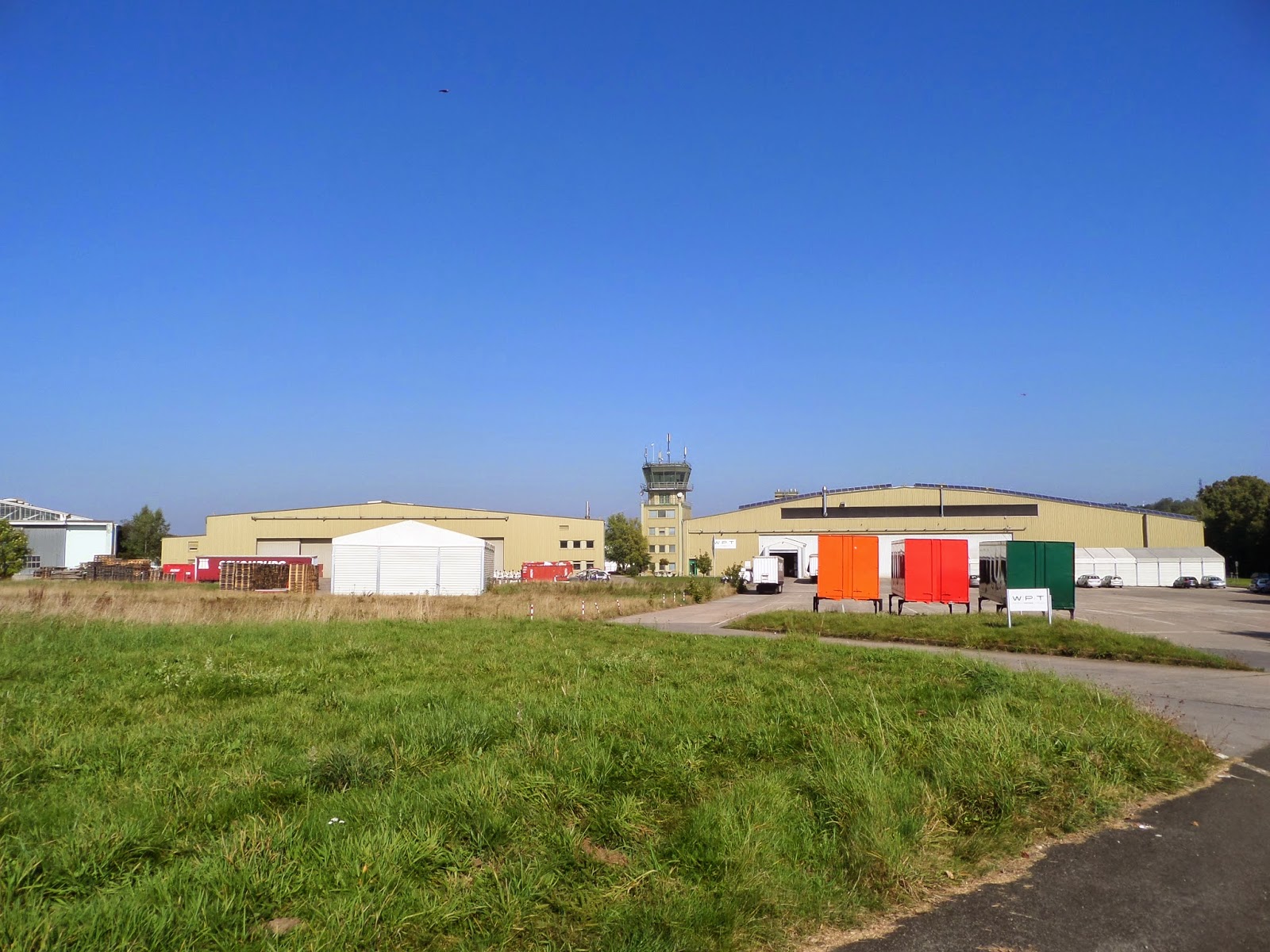
We then headed in the direction of where I thought the base was. The base is all public land and buildings now, with most of the buildings closed up, but many of the hangars have been taken over by businesses for commercial ventures. There was one business called Hangar 21 which I have since discovered holds cultural and entertainment events in a cleaned up hangar:
Hangar 21 


What was quite strange was that the control tower is also still standing. Land had been cleared on the edge of the base where there once would have been hangars, and a supermarket built, and there is a new road network being constructed near there. I would guess that in time the unused buildings will be cleared, and the area will change completely.


It was nice to see people walking their dogs on what was the airfield, and the area did still seem to have an edge of town feel. Maybe in the absence of any physical monument to remember the many thousands of British service men and women who served there in the Cold War, and of course the German Luftwaffe personnel who served there during the Second World War and before, it would be good if the land remained as a public open area. . .


That was stage one of the stroll down childhood memory lane, and we headed down into Detmold town itself. To be honest I don't remember much about the town other than the castle, which being a castle is still there. 


It's a pretty town, and after a stroll we found a nice bar, a bit trendy, 


but with outside seating in the sun to enjoy our first beer in Germany. 


Lunch was a little less enjoyable!


After picking up a few leaflets at the tourist office, the next place on the tour was Hermannsdenkmal. Whenever someone visited from the UK, this was one of the nearest interesting places to take them. As a child the statue was just an impressive statue, so going back 50 years later it was still an impressive statue, but I could now attach some very interesting history to its origin. I seem to remember dad being able to drive quite close to the statue, but there is now a massive car park (with charges!) and a reasonable stroll through the trees to the base of the statue.
http://en.wikipedia.org/wiki/Hermannsdenkmal


From there the next visit on the tour was to Die Externsteine, which is a geological feature of 5 sandstone pillars, not far from Horn where we first lived in Germany. Again a popular place to take family from the UK when they visited. 


Nothing much has changed in 50 years – not surprising in rocks that have been there millions of years. But I seem to remember being able to see the rocks from the road where now you drive up to a car park and walk to the rocks. We had bought a joint ticket to climb up inside Hermannsdenkmal, and then to the top of Die Externsteine – but one climb in a day was enough to be honest!


It has taken some time to write this post, but in googling some of the places we have visited, and things we have done, it has been really interesting to find things that have changed. For example, at Die Externsteine in 1958 there were around 224,000 visitors a year, and I would guess this was around the same a few years later when we used to visit. This compares with visitor numbers of up to a million today, which probably explains the elaborate visitor displays, car parks, bar and restaurant that were not there in the 60's. And the reason why the road may have been routed away from the rocks.
http://en.wikipedia.org/wiki/Externsteine

It started to rain as we left Die Externsteine, but there was still enough of the day left to return into Detmold and find the Detmold Brauhaus and enjoy a "pint" of the local brew.

"Baby" brother Adrian suggested when we spoke recently that it must have been an emotional return. It was. But in a very positive way. Even as a 10 year old (at the oldest) we had some great times, and very happy times. It enabled us as a family to travel much more than we had ever done before. We had memorable camping holidays in Holland and Italy, and in travelling South to Italy, also visited Austria and Switzerland.
All in dad's Ford Taunus – VF 94 B ! Like the address in Detmold, I remember that too!
The only negative emotion is that they aren't around for me to ask questions about the time in Germany. . .

While we were in Detmold, Gail and I also visited some of the day-trip destinations I remember from my childhood there - Hamelin, and the Möhne and Eder dams, but it is best I leave those stories for another day.


Tuesday, 16 September 2014

Back in Europe


Tuesday September 16, 2014

We are back in mainland Europe. To be precise we are in walking distance of Bruges in Belgium. We have been here many times before, but it's a place that is always a pleasure to visit and spend some time in. Although it is mid September, clearly other people think the same, as there are many tourists visiting. It's expensive eating and drinking here, but I think that may reflect what to expect as we move on to Germany in a few days. We paid £35 for a bowl of mussels, bread and a plate of chips, which we shared, plus 2 beers.

Reflecting on the past few months we are really happy with the great summer we have enjoyed. We are so lucky to have been able to spend so much time with Kate, Paul and Amelia. It is quite amazing that since we came back to the UK in May, and leaving again in September, we have seen Amelia walking, and now running. And every day she seems to pick up new words. She can even say multi syllable words like "caravan". I'm not joking – she really can say "GraGra and GaGa's caravan"! 

Amelia actually said "Granddad" one day, which was disappointing that she was learning so fast, but it was back to GraGra again soon. She knows most of the words for colours, but at the moment nearly everything is blue! But we have no doubt she will soon know that Peppa Pig is pink. We are learning too. Peppa's brother is George; her teacher is Mrs. Antelope; and her friends are Danny Dog, Emily Elephant (Mike's favourite), and Susie Cat – we think that's right – please correct if not. . . .

And some of the time with Kate, Paul and Amelia, and meeting up with other family, has nicely coincided with enjoying places and events in the UK: Cowes Week; visits to Mottisfont House near Romsey 


and a couple of National Trust sites in Devon; 


the Tall Ships race start in Falmouth; a trip on the ferry from Padstow to Rock; a walk on the cliffs near Bedruthan Steps, while looking at a very rough and stormy sea over the August Bank Holiday.


On the subject of some of these places, we were asked before retirement what we planned to do, and Mike's practiced answer was "to visit old and new places in Europe and similarly in the UK". And that is what we have done in the UK this summer – perhaps not as adventurous as we had thought – but there was no need, as there was so much to do anyway. Gail lived in Cornwall for 50 years, and Mike as an emmet for only 40! But neither of us had ever been to Bedruthan Steps, or crossed the River Camel to Rock.

It suddenly occurred to us the other day that we might be too late to achieve our goal of seeing old and new places in the UK. If there is a "Yes" vote in Scotland, then we have another country to visit, and the UK becomes smaller. It makes you think – in the last few days we have driven into France, crossed the border into Belgium, drifted into Holland, back into Belgium, and tomorrow will probably drive into Holland again, and out into Germany without once showing our passports. Wonder if it will be as easy if Scotland is independent. . .
And by the way – why do we get so much immigration hassle when we fly, but not when we drive, or travel by Eurostar? Answers on a postcard please!


Friday, 15 August 2014

Back in UK . . .


For some reason – could be Word, or Google Blogger, or me – this post kept overwriting others. So sorry if you have read it before. . .


For three months now, we have been back in a world where WiFi access is easy and free– that is not in France and Spain – so I have had no real excuse to not catch up on stuff without worrying about the cost!
I can't really blame the lack of WiFi for neglecting the blog. It was the sun's fault! Very lazy and relaxing life... Ironically I have now left my phone in the car and it's a bit early to go out and get it, so I'll type this as a draft and send later!
We had the occasional WiFi in Spanish bars and paid for internet boosters but 100MB about covered a FaceTime call to Kate.

They had cheap WiFi on our main site in Spain for just 30 euros a month, but it was poor quality, so I did it once.


We didn't travel around Spain as much as we expected as we found a great site half way between Valencia and Alicante right on a beach with clean sand as far as you could see in both directions.

But of course we took trips to various towns and cities, including a few overnight hotel stops.

The site was very uncrowded even at Easter and May Day holiday when there were a lot of Spanish around. And only 14 euros a day! We planned to stay for 7 days and ended up being there for 72 days!

The car was a pain – and still was in the UK until late July. We had to get recovered (fortunately without the caravan) and then the car needed a new driveshaft; the front number plate half fell off (Halfords!) and I got pulled over by gendarmes. Fortunately no "on the spot fine". Then we started to get an intermittent engine performance issue - took a chance and managed to get back to the UK. Then the aircon packed in a week before leaving Spain. Got it regassed but still not fixed. That week and 2 days of driving back were a little uncomfortable and noisy with windows open, but that was not a problem once closer to the UK, although the improving UK weather eventually tested us again.
Finally the computer display faded and went out. It's not a big display, so again was not a big deal but it would have been nicer to have it.

To cut a long and boring story short, all jobs on the car were eventually fixed over a few months – including a further major engine job. Don't ask how much! Let's just say we will be in the caravan a while longer. . .

We made it back to a site near Southampton, next door to a caravan service centre where they serviced the caravan for the first time. As Gail had said, our list of "warranty items" was not long, and might be put down to wear and tear, and generally the caravan's first year has been reliable, certainly where you want it to be - behind the car, and on a site.

Once we got back to the UK it was a busy time, sorting out a storage unit in Southampton to transfer stuff from the Derby storage unit; emptying the caravan into the unit so they could service it; and of course catching up with Kate, Paul, and Amelia. I am now "GraGra", Gail was "GrauGrau" which has already evolved to "GaGa", which we both love, but we have been corrected by Kate that we must repeat back to Amelia "Grandad" and "Granny". Quite right!

Since May we have been moving around to various caravan sites around Southampton and the New Forest, for a few weeks at a time. Just yesterday we returned from a 2 week visit to the Isle of Wight which is deserving of its own blog post one day! Once again all very relaxing and lazy!

We are now back in Southampton for a few more days before heading down to Cornwall for a few weeks, via a stop on Dartmoor. The really good weather has gone, but it's not so bad even now, and we are really looking forward to our first visit to Falmouth in 2 years.

Wednesday, 26 March 2014

Bucket List

Tuesday, March 25, 2014

Well! Since we arrived in Spain over 6 weeks ago, this is the first afternoon of solid cloud we have seen, and very windy with it. So instead of being lazy and concentrating on doing nothing in the sun, an opportunity to start a blog post.

I loved the film “The Bucket List” with Jack Nicholson and Morgan Freeman, 
The Bucket List (2007) Poster
and fully get the idea of listing things and challenges to do, or to see or to experience, and then ticking them off the list, bluntly before you “Kick the Bucket”! 
Don’t worry – I will be around for a while yet! 
Personally, and in my opinion, setting goals in life and career can only bring frustration and disappointment when not achieved or only partly achieved. And unfortunately with the good things come the bad things – some unexpected, but many inevitable in the course of life.

But at the same time I am very lucky that life has resulted in me being able to say that! 
If I now write a retrospective list of things that I have done, or seen or experienced, since just the start of the 21st Century, in my personal world and sometimes as a result of my job, often shared with Gail, Kate and Paul, and family and friends, my so-called “Bucket List” is actually quite long, and having ticked them off very satisfying. Things that money can’t buy such as seeing our daughter, Kate, graduating from University and then successfully developing a successful career; meeting and then marrying a good man in Paul, and together making a happy home together into which our granddaughter Amelia arrived in 2012, is a series of "items" which would have to be at the top of the list. 
I would also have to follow with a list of people who I met through work, many of whom became good friends, and provided a long string of happy and memorable events, including weddings, births, christenings etc.

Then we have had great holidays - in USA (including Hawaii), Australia, Thailand, Vietnam, Ireland, Barbados, France, Italy, Spain, not forgetting many good breaks in the UK; work trips - many more than once, to South Korea, China, Malaysia, Indonesia, Thailand, Australia, Sweden, Slovenia, Finland, Norway, Russia, Ukraine, Turkey, France, Germany, Switzerland, Austria. From such holidays and visits, highlights of these could be additions to the Bucket List – seeing the Barrier Reef, flying over a volcano in Hawaii, looking towards North Korea over the border, visiting the Grand Canyon, seeing the Northern Lights . . .


And what about. . .? That’s the point of this post. I think if I had written a Bucket List, many of the above and many other things would not have been there. And then just last week we experienced another unexpected event here in Spain, to add to the retrospective Bucket List. 
But that’s another blog post to come – “Fallas 2014”.

Tuesday, 18 March 2014

Falles – March 18, 2014, Valencia


If I had a Bucket List, the Valencia Falles (Fallas in Spanish) would not have been on it! But only because before we actually arrived in Spain we had never heard of it! Having experienced it, the Falles are definitely on my retrospective Bucket List. We knew that as with other countries, in the spring, Spain have festivals and carnivals, and we took a look on the internet to see if anything was going on locally. We found out that Oliva which is a town in the Valencia region a few kilometres from where we were staying in March 2014, celebrate Falles. During a visit to Denia, another nearby town, we came across a huge sculpture in a side street which was clearly going to be the centre piece of an important local event.

Early the next day, I was telling some Dutch neighbours about this, and they told me that a crowd of Dutch and Germans had recently been to Valencia on a coach trip, and if we wanted to experience the Falles we really should go to Valencia. The book they loaned us confirmed that this was clearly a big event. Falles refers to both the celebration and the monuments created during the traditional celebration commemoration of Saint Joseph.

As we had already thought about an overnight stay in a Valencian hotel to see the sights, we booked a hotel for the following Monday and Tuesday nights which were the last nights of Falles 2014 in Valencia. The Sat Nav took us as far as the barricades blocking off the city centre where our hotel was! We tried navigating another route, but after 30 minutes and a lot of stress in heavy Spanish city traffic, as we only appeared to be 1 kilometre from the hotel by car, and even less if we were to walk, we drove into the nearest multi-storey underground parking, and squeezed into one of the last remaining, and the narrowest space. It must have been narrow because someone managed to put a nice scrape on the wheel arch while we were there! Anyway, we decided to leave the case in the car and get our bearings on the surface so to speak. Google Maps gave us a route which looked reasonably direct, and only 10 minutes' walk, so after a coffee we picked up the overnight case from the car and set off.

Following the direct route, we were just a few hundred metres from our hotel when our route was completely blocked approaching a large square by thousands of people, all close together, clearly waiting for something to happen. We decided to walk back 50 metres then run parallel to the recommended route, and finally got to our hotel. The welcome was good, and the room very good. The receptionist had given us a timetable of events, and it was clear from this, that all the people who had "blocked" our route were waiting for the Mascletà, whatever that might be. At 2 pm, while still getting ready to leave the room, we heard the Mascletà with some very loud firework explosions. On entering the street the air was filled with smoke, and people leaving the area after the Mascletà. We were in the street the following day to witness this daily event, so more on this later. . .

We started to wander, and found a bar in a side street to enjoy the sun and atmosphere from one of the outside tables. What we did not know until after we had been was that the two days we had picked were the only days when the festivity includes a flower offering to Our Lady of the Forsaken, which has taken place since 1945. Two full afternoons are dedicated to the parades composed of all the Fallas Commissions, headed by the Fallas Queens and their Courts of Honour followed by standard bearers and marching bands in a ceremony in which traditional costumes and flower bouquets are the major attractions.
We gradually realised from the barriers on the main street, the build-up of people, and from the Fallas schedule that the daily procession would pass in the main road near our bar. So we crossed the road to a vantage point, and waited for the start of the procession at 4. 


Of course we had no idea that the start of the procession was some 30 minutes away – but never mind, when it arrived it was worth waiting for & we watched the Falleras, 


Falleros and quite often their babies and children pass in their elaborate traditional colourful costumes.


The ladies (Falleras) each carried a posy of white or red flowers, the purpose of which we only found out later.


There were even groups of falleras pushing buggies as if they might belong to a mum's group – we will never know! 


Probably the most interesting realisation was that each section of the procession was from a different district (or barrio as we later discovered) and people watching recognised and clapped people they knew.

Each "Barrio" had its own band playing traditional music. It was quite something.


After a couple of hours of this, as fascinating as it was, like a lot of things, interest was waning. . . Gail was keen to see the end of the procession, but with hindsight persuading her to leave was a good idea – it went on until midnight – another 6 hours! So we returned to the hotel to tidy up for dinner, and a wander of the area around the Ayuntamiento (the main square). The area was lively, with the usual street sellers selling balloons and the latest plastic light up stuff from China.

I had left the schedule in the hotel but had the street map, so headed towards the area where the night's fireworks would take place. We knew we were in the right area by the crowds of people, and confirmed when the local police moved everyone from a seating area to the road, but we were still in a good position. Just as an aside isn't it curious how you hear people – everywhere - complaining they have people in front of them, when the fireworks are in the sky?. . . It was way past our bed-time at 1 in the morning, and on our feet for many hours, when the fireworks finally started – and they were worth waiting for. The Spanish economy may be in the shit, but that's not going to stop them throwing a great party! At the same time, there are clearly a lot of Spanish and foreign tourists brought to Valencia by the organisation and spectacular events.

The following morning, we took an early lunch at a bar next to the hotel,


and then headed to where the previous day's procession had ended up, and the procession due later that day would also head for – Valencia Cathedral. In the square beside this cathedral was a massive figure of the Virgen de los Desamparados (Our Lady of the Forsaken), with the flowers that had been brought to the square decorating the figure. 


It was not complete, and we assumed the final day of processions would make this complete.


We did not even attempt to see this happening, as it was clear this would be a busy area, but we saw on the local TV channel later in the week that this was the case, and the falleras were very emotional as they delivered their flowers.


It was getting near the time for the daily Mascletà at the Ayuntamiento (the main city square). 

As we got closer it was clear we could get nowhere near as all the side streets leading to the area were jammed packed with people, as they had been the previous day approaching our hotel. So we waited patiently and at 2 it started. I can only describe it as a firecracker display in broad daylight! Incredibly noisy bangs and explosions, and lots of smoke even though we could not see the square. It went on for 10 minutes, and at the end there was massive clapping and cheering at street level and from all of the office and building windows around us. Our ears were ringing with the effect of the bangs.
There are much better videos than mine on YouTube but here it is anyway:


Clip edited to 30 Seconds

Full 100 second clip

Later in the day we found our way to the square and could see that the firecrackers had been set off in a massive cage in the centre of the square.
(Click here to see cage but this is not my photo!)


The rest of the second day we just spent wandering, and enjoying the atmosphere.


As we walked we had glimpses of the huge figurines made of papier-mâché similar to those we had first seen in Denia the previous week.

With a city the size of Valencia it seemed that every corner you turned you saw such a figurine or group of figurines. 


These were often comic in style and often portray caricatures of local politicians, and celebrities like footballers and TV personalities. There are different categories in this with a competition going on, the winners being spared from being burnt on the night of 19 March, St Joseph's Day. 


There was a massive statue in the Ayuntamento which was difficult to imagine was papier-mâché.This was one of the statues that ended up being burnt. 


We didn't stay to see this part of the celebrations, but we saw it on local TV the following day. Flames were higher than the buildings around the square, and people were crying with emotion. Apparently the whole night sky lights up with flame as all the months of hard work goes up in flames. . .
Statues on Fire - Original available at: http://www.travelsages.com/wp-content/uploads/2014/03/DSC_3051.jpg

In conclusion, and looking back some months now, it was a really good few days. 
Although this is a celebration that has been going on for many years, it is something we had never heard of before. We are already wondering how we can plan to be there again in 2015.